In partnership with

If you’re new here, welcome! If you’ve been reading for a while, thank you for sticking around as we navigate this wild AI shaped shift happening across eCommerce. Each week I share what I’m experimenting with, what’s actually moving the needle, and the trends that deserve your attention before they hit your competitors’ playbooks.
A quick heads up. I’ve organized all previous editions into one searchable hub. If you want the full journey, it’s all here.
Ambient AI and the Rise of the Invisible Storefront
For twenty years, ecommerce obsessed over the eye. Better photos. Cleaner layouts. Faster loads. A quiet belief that if it looked good enough, someone would buy. We built systems designed to impress humans who were willing to browse, compare, and decide for themselves.
We spent decades polishing the surface of ecommerce, perfecting images, copy, and layouts built to dazzle. But the signal coming out of CES and the NRF Big Show was unmistakable. Intelligence is leaving the interface and moving into the plumbing.

One idea kept resurfacing in different forms. We are in the Year of the AI Agent. Digital commerce already accounts for more than half of retail transactions, and now, in a growing number of cases, the first customer is no longer human. It is an agent acting on someone’s behalf. On Amazon, that agent is Amazon Rufus. It is Alexa Plus.

Your storefront is no longer designed for browsing. It is designed for final selection. By the time a shopper lands on your page, the real evaluation has often already happened somewhere else.
At NRF 2026, Shopify and Google introduced the Universal Commerce Protocol, an open standard designed to let AI agents connect to merchants and complete transactions autonomously. That detail matters because it removes the last assumption that a human must always be present at checkout. The loop is closing because Ambient AI is here.
The invisible storefront is the reality where buying decisions are made by AI agents upstream, and your brand only exists if it can be clearly understood, compared, and chosen before a human ever sees the page.

AMBIENT AI
From destination to integration
We are moving away from destination commerce, where shopping meant going somewhere and searching. We are entering ambient commerce, where buying happens where you already are. Voice assistants, predictive prompts, and background decisions replace deliberate journeys.
The search bar fades into the background. Typing becomes optional. Intent is inferred from context, history, and constraints. As a result, SEO quietly gives way to Answer Engine Optimization, not ranking pages, but supplying certainty.
This is the Zero UI world. Commerce becomes a trigger, not a trip.

The machine to machine economy
This is the deeper shift underneath all of it. Humans are no longer the primary gatekeepers. Their agents are. We are entering a machine to machine economy where software evaluates options, compares tradeoffs, and makes recommendations before a person even looks.
If your product cannot be clearly understood by an agent, it effectively does not exist.
A useful analogy surfaced at NRF. Tools built for people with visual impairments translate the visual web into structured meaning so it can be navigated confidently. Your storefront now has to perform the same translation for AI agents. If the bot cannot see your value through data, you are closed.
How to build an invisible storefront
The idea is not to look better, it is about being clearer.
🔶 Attribute density
Every backend field matters. Materials, dimensions, weight, use cases, constraints. Agents filter on specifics, not vibes.
🔶 Semantic narratives
Bullet points should answer objections, not decorate features. Rufus matches intent, not adjectives. Benefits beat polish.
🔶 Conversational Q and A
Your FAQ is no longer defensive copy. It is training data. Comparisons, tradeoffs, and pros and cons are what agents summarize out loud.
The quiet advantage
Most brands will respond to Ambient AI by producing more content. That instinct is right. But in an agent-driven market, content only works when it increases certainty. Unstructured volume slows selection. Structured depth speeds it up.
Your website does not disappear, but its role changes. It becomes a verification layer, where humans go only when the agent needs confirmation. The real competition happens earlier, inside the structured truth an AI uses to classify, compare, and justify a recommendation.
The brands that win will not be the ones with less content or louder messaging. They will be the ones whose content removes doubt fastest. Easy to explain. Easy to compare. Easy to choose.
PPC Ninja is helping brands future proof their listings for AI, helping you build RUFUS enabled, stunning images and videos with AI. Hit reply on this to chat with us. Explore how we can scale your content production across Social media, Amazon ads, Amazon Posts efficiently and affordably.

Deploy Google AppScript by Chatting with AI
I create a lot of Google AppScripts for all kinds of use cases. You’ve heard me talk about my mini apps living inside the Google ecosystem. Recently, I ran across a SUPER handy method that cut my build time even further.
The magic ingredient is Clasp. It’s a small command line tool from Google that lets scripts be created, updated, and deployed without opening the Script Editor.
No copying. No pasting. No spreadsheet gymnastics. On a Mac, I install it through Homebrew. On Windows, it’s the same idea without Brew. Install once, sign in once, and your computer is trusted to manage Apps Script projects for you.
brew install node
npm install -g @google/clasp

AUTHENTICATE ONCE:
clasp login
Here’s where it gets interesting. I’ve hooked this up to Claude Code. That means I can talk through what I want, Claude writes the Apps Script files, and then actually runs the command line steps to push and deploy the script using clasp. I’m not just getting code back. I’m getting working software dropped straight into my Google account.
The shift is subtle but huge. Apps Script stops being something you “implement” and starts being something you describe. If you can explain a workflow, you can build it. Clasp just handles the boring logistics in the background while AI does the heavy lifting.

The Backlash from Shopify Owners
Last week, Amazon got caught building agentic features on top of independent ecommerce websites without their permission. In the context of what everyone else in the industry is working on, that felt out of place. Amazon is hacking together a prototype Buy for Me function while also fighting every major AI lab that wants to train on its data. Meanwhile, the rest of the ecosystem is doing the unglamorous work of building shared foundations. Protocols. Integrations. Agreements. Like the recent Universal Commerce Protocol backed by Google and two dozen partners.
Here is a viral video that talks about what happened:
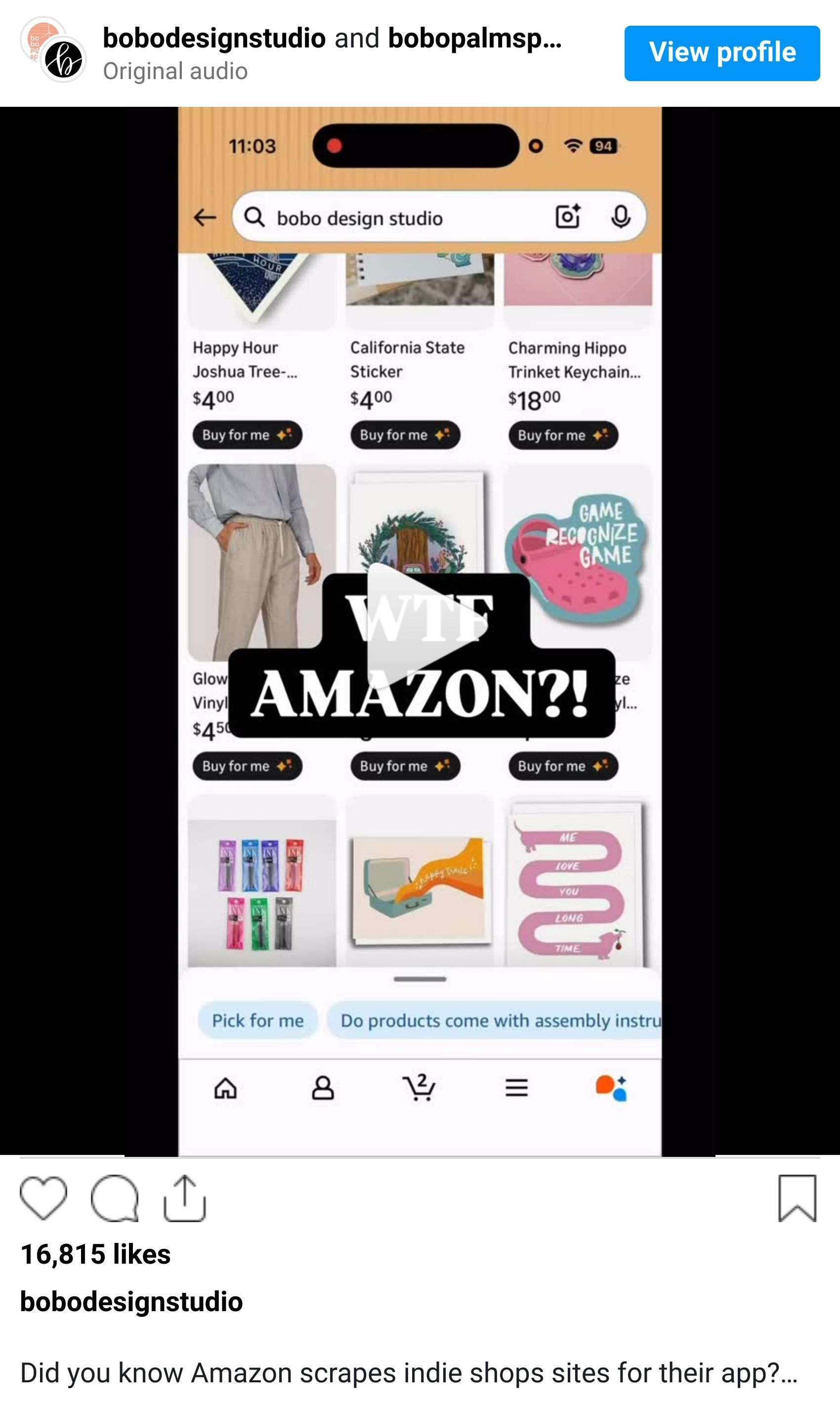
The backlash from Shopify sellers is a tell. When Buy for Me started scraping independent stores and replaying them inside Amazon, the issue wasn’t legality. It was intent. Invisible storefronts still have owners. Agents still act on someone’s behalf. Pretending that layer is neutral is how trust breaks quietly.
Juozas Kaziukėnas wrote an insightful post highlighting this. Read the full piece:


Super excited to be speaking at the Billion Dollar Seller Summit BDSS 13, and AI-focused event hosted by Kevin King. RSVP: https://www.bdss13.com

Join me for this incredible Hack Contest on Jan 28th organized by Smart Scout and Nick Penev. RSVP here.

We hope you liked this edition of the AI for E-Commerce Newsletter! Hit reply and let us know what you think! Thank you for being a subscriber! Know anyone who might be interested to receive this newsletter? Share it with them and they will thank you for it! 😃 Ritu

Tech moves fast, but you're still playing catch-up?
That's exactly why 100K+ engineers working at Google, Meta, and Apple read The Code twice a week.
Here's what you get:
Curated tech news that shapes your career - Filtered from thousands of sources so you know what's coming 6 months early.
Practical resources you can use immediately - Real tutorials and tools that solve actual engineering problems.
Research papers and insights decoded - We break down complex tech so you understand what matters.
All delivered twice a week in just 2 short emails.
